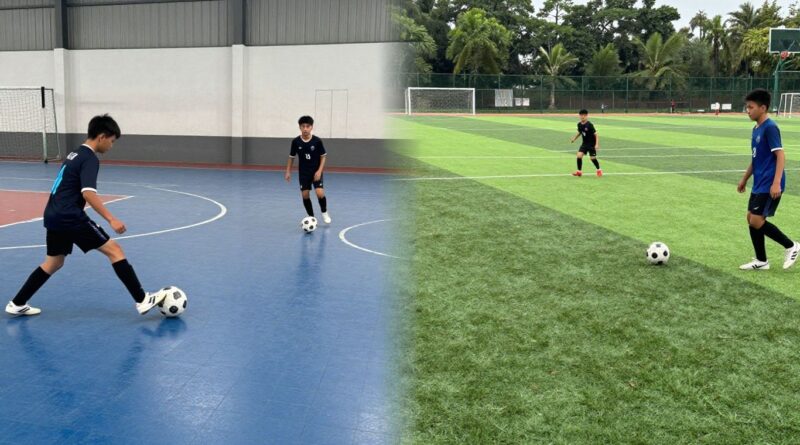
Futsal vs outdoor soccer: What’s the difference?
Key Takeaways
Futsal and outdoor soccer share the same aim, but their settings encourage different rhythms and decisions. We can use the contrast to choose a format that suits our players, venue and development goals.
- Futsal is played on a compact, hard court, while outdoor soccer gives players more room to move.
- Team numbers, restarts and timekeeping can differ, so we should check the competition rules.
- A futsal ball is typically smaller and less lively off the surface than an outdoor ball.
- Futsal rewards close control and quick combinations; outdoor play asks for movement across larger spaces.
- Playing both formats can help young players practise a broader range of skills.
How the playing surfaces and settings differ
The setting changes what players see and how much room they have to act. Futsal is usually played on a hard, level court, while outdoor soccer is played on a larger field that may be natural grass or synthetic turf. Those differences affect movement, ball behaviour and the way teams use space, even before the rules come into play.
Futsal courts are smaller and usually hard-surfaced
A futsal court is compact, with touchlines and goal lines marking the playing area rather than walls keeping the ball in play. Courts are generally hard and even, though the precise surface and dimensions can vary by venue and competition. With less ground to cover, players are often close to teammates and opponents, so a first touch or quick change of direction matters straight away.
Outdoor soccer fields offer more space and varied surfaces
Outdoor soccer fields give teams room to spread out, make runs beyond the ball and switch play across the pitch. The surface is commonly grass or artificial turf, and its grip and consistency can change with maintenance and weather. Field size also varies, particularly in junior football, where formats are often adapted to players’ ages and stages.
How indoor and outdoor conditions affect play
A sheltered court can make conditions more consistent, although indoor venues may still differ in temperature, lighting and floor grip. Outdoors, wind, rain, heat and the state of the surface can all influence a pass or a player’s footing. We can help young players adapt by asking them to notice the conditions early, then adjust the weight and direction of their passes.
How the rules shape each game
The basic aim is familiar: work together to score and prevent the other team from scoring. The details, however, shape the flow of play. Futsal rules commonly use smaller teams and kick-ins, while outdoor soccer typically has larger sides and throw-ins; particular competitions may vary, especially for junior players.
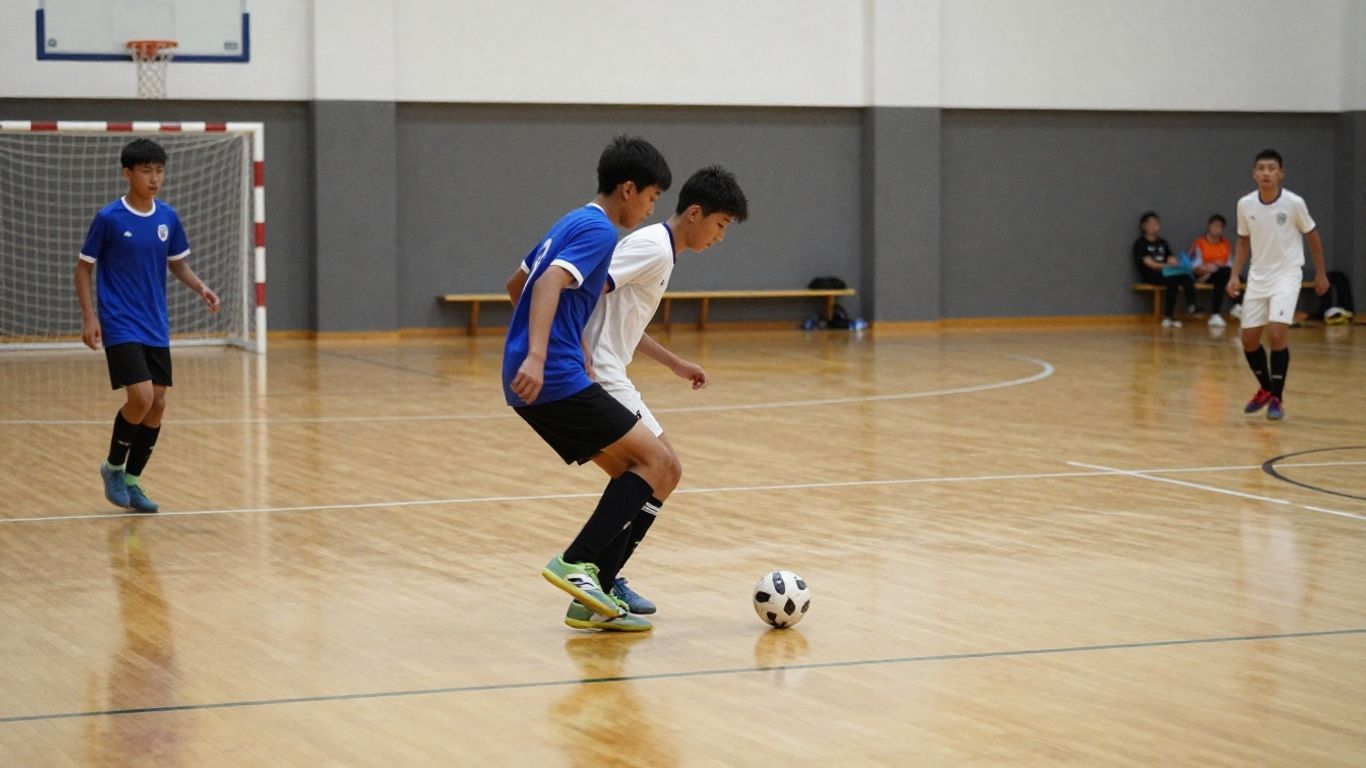
Team sizes and substitutions
Futsal is commonly played five a side, including the goalkeeper, with substitutions that can be made during play under the applicable rules. The standard outdoor game is eleven a side, though junior leagues often use smaller formats and modified substitution rules. This comparison is a useful starting point, not a substitute for the competition handbook:
| Feature | Futsal | Outdoor soccer |
|---|---|---|
| Typical team size | Five players, including the goalkeeper | Eleven players in the standard game |
| Substitutions | Often rolling substitutions | Depends on competition rules |
| Playing area | Compact court | Larger field |
| Ball out at the sideline | Kick-in | Throw-in |
These formats change the number of passing options and the distances players need to cover. Before a match, we should confirm local rules rather than assume every age group uses the adult version.
Kick-ins, throw-ins, and restarts
When the ball goes out over a sideline in futsal, play commonly restarts with a kick-in. Outdoor soccer uses a throw-in, giving players a different technique to practise and a different way to return the ball to play. Goal clearances, corners and free kicks also have their own procedures in each format, so a brief team reminder can prevent confusion during a close game.
Fouls, accumulated fouls, and timekeeping
Futsal competitions commonly keep track of accumulated team fouls, and some use a stopped clock or specific restart time limits. Outdoor matches more often use a running clock, with timekeeping and match length set by the competition. Foul definitions and consequences are governed by the relevant rules, so coaches should explain the version being used rather than relying on assumptions from another format.
How the ball changes the game
A ball is not just a piece of equipment; it shapes the touch players receive and the choices they make next. Futsal balls are designed for a compact court, while outdoor balls are suited to the larger field and its surface. Choosing the appropriate ball for the session helps players practise with the conditions they will actually encounter.
Why futsal balls are smaller and have less bounce
A futsal ball is generally smaller than a standard outdoor ball and has reduced bounce. That lower rebound helps keep play controlled on a hard court, where a livelier ball could move away quickly after a touch. Players still need to cushion passes and keep the ball close, but the ball’s behaviour encourages them to make those adjustments in tight spaces.
How a standard outdoor ball behaves on grass
An outdoor ball is designed for the demands of a larger field. On grass, it may roll differently depending on how long or wet the surface is, while a pass can travel further before slowing down than it would on a compact court. Players learn to judge the pace of the ball and the space available, then choose between carrying it, passing into space or changing the point of attack.
Choosing the right ball for each surface
For a training session, we should match the ball to the format and check that its size suits the players and competition. A suitable ball makes practice more representative and helps players build confidence in the touches they will use during a match. A simple equipment check also prevents a session from becoming an unintended lesson in managing the wrong bounce.
How pace, tactics, and skills compare
Both formats ask players to read the game, support one another and make sound decisions. The difference is the space and time available to do so. In futsal, pressure can arrive quickly; outdoors, players may have more room to scan, move and exploit a longer passing lane.
Quick passing and close control in futsal
The compact court encourages players to receive under pressure and decide what to do with the ball in a short space. A sharp first touch, a quick pass and a move to offer support can help a team keep possession. Because opponents are nearby, players also practise shielding the ball and finding a route forward without needing a long run-up.
Space, movement, and longer passes outdoors
On a larger field, players can create space by moving away from the ball or by making a run beyond the defensive line. Longer passes and switches of play can help a team use the width of the pitch, while players must also judge when to retain possession. The bigger area asks for awareness off the ball as much as accurate passing.
How each format can build transferable soccer skills
The futsal vs outdoor comparison is not a choice between useful and less useful football. Each format gives players different situations in which to practise technique, awareness and teamwork. Close control can help when an outdoor player is pressed, and the movement learned on a full field can help a futsal player recognise space before it closes.
What players need to wear and bring
The right kit depends on the surface, venue and weather. Shoes need to suit the playing area, and the rest of a player’s gear should be comfortable and appropriate for the session. We can make preparation simple by checking the venue information before leaving home.
Shoes for futsal courts
Futsal is generally played in court shoes with flat, non-marking soles that provide grip on the indoor surface. The court’s rules may specify which footwear is permitted, so players should check with the venue or organiser. Shoes that fit securely help players move and change direction without relying on outdoor studs.
Cleats for outdoor fields
Outdoor footwear is chosen for the field surface and conditions. Cleats or moulded studs can provide traction on grass, while artificial turf may call for a different sole pattern; the venue’s guidance is the best reference. We should avoid assuming one pair will suit every pitch, particularly when the surface is wet or unusually firm.
Gear and preparation for different weather
Outdoor sessions call for a little more planning because conditions can change between arrival and kick-off. A compact pre-session check can help players arrive ready without bringing unnecessary kit:
- Confirm the surface and footwear guidance with the venue.
- Pack water and a spare top for after the session.
- Bring a light layer for cooler or windy outdoor conditions.
- Check whether the session is indoors or exposed to rain and sun.
The essentials will vary with the venue and session length, but these small checks make it easier to focus on football once play begins. For futsal, we can also check court rules and bring a ball suited to the session if players are expected to provide one.
Which format is right for you?
There is no single best format for every player or club. Our choice can depend on the facilities available, the kind of match experience we want and the skills we hope to practise. We can also use both formats across a season, provided the schedule and rules are clear to players and families.
Choose futsal for fast play in a compact space
Futsal suits players who enjoy close combinations, frequent involvement and making decisions under pressure. Its smaller playing area can make a useful option when a club has access to a suitable court or wants to offer football in a compact venue. We should still consider the players’ ages, experience and enjoyment when choosing the format.
Choose outdoor soccer for open-field play
Outdoor soccer is a natural fit when players want to practise using a larger pitch, moving into space and connecting passes over longer distances. It also brings the variety of playing on grass or artificial turf and adapting to the weather. For a club, the field format should match its competition and the needs of the age group.
Try both to develop a more complete game
Players do not have to choose one format for good. Futsal can give them a chance to practise close control and quick decisions, while outdoor soccer gives them room to work on movement across a bigger area. With supportive coaching, both can contribute to a broad football education and keep the game varied.
Frequently Asked Questions
Is futsal the same as indoor soccer?
Not always. Futsal has its own rules and is typically played on a hard court without walls, while other indoor soccer formats may use different surfaces, boundaries and rules.
How many players are on a futsal team?
The common format has five players on court per team, including the goalkeeper. Local and junior competitions may have their own arrangements, so check the rules for the match.
Is futsal played with a smaller ball?
Yes. A futsal ball is generally smaller and has less bounce than a standard outdoor ball, helping suit the pace and surface of the game.
Can we play futsal outdoors?
Futsal can be played on a suitable outdoor court, provided the surface and conditions are appropriate. The key distinction is the court and the rules, rather than simply whether the venue has a roof.
What is the main difference between futsal and outdoor soccer?
The playing area is a major difference: futsal uses a compact court, while outdoor soccer is played on a larger field. Team sizes, restarts, ball and match rules also differ.
Which format is better for young players?
Neither format is automatically better for every child. Both offer different opportunities to practise football skills, and the best choice depends on the player, the coaching environment and the rules of the age group.
Do players need different shoes for futsal and outdoor soccer?
Usually. Futsal courts call for suitable flat-soled court shoes, while outdoor footwear should match the field surface. Players should follow venue guidance before taking the pitch.