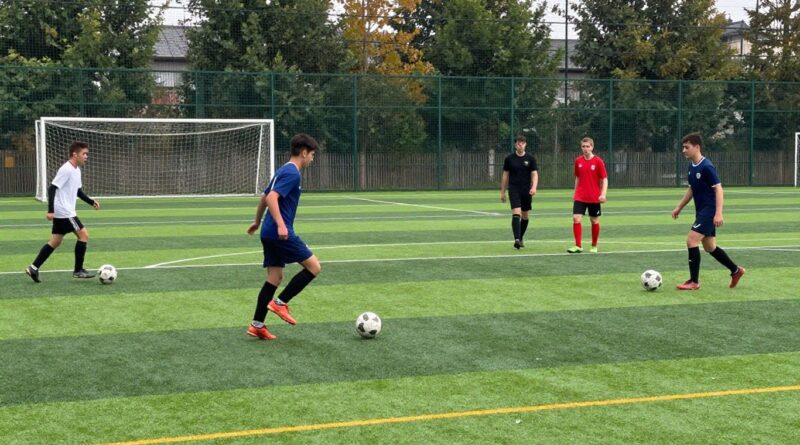
Futsal vs outdoor soccer: Key differences, benefits, and how to choose
Key Takeaways
Futsal and outdoor soccer share the same basic aim, but they ask players to solve very different problems. We can use the comparison to choose a format that suits our development, fitness, and enjoyment.
- Futsal uses smaller teams, a hard court, and a low-bounce ball.
- Outdoor soccer gives players more space, longer running distances, and greater tactical width.
- Futsal rewards quick decisions and close control under pressure.
- Outdoor soccer develops positioning, endurance, and full-field awareness.
- Combining both formats can give young players a broad and useful football education.
What sets futsal and outdoor soccer apart
The phrase futsal vs outdoor describes more than an indoor version of the same sport. Both games involve passing, defending, creating chances, and protecting the ball, yet the setting changes how often those actions happen. We should understand the basic structure before deciding which format suits a player or team.
Team size and player positions
Futsal is generally played with five players per side, including a goalkeeper. With fewer teammates sharing the court, every player has to contribute in attack and defence, and positions tend to be fluid. Outdoor soccer is commonly played with 11 players per side, creating more specialised roles such as fullbacks, midfielders, wingers, and centre-forwards.
That difference affects responsibility. A futsal player may move from defending a corner to supporting an attack within seconds, while an outdoor player may spend longer managing a particular area of the pitch.
Court and field dimensions
A futsal court is much smaller than an outdoor football field and is marked with touchlines rather than relying on surrounding walls. Outdoor fields provide considerably more room to carry the ball, switch play, and run beyond a defender. The exact dimensions can vary between venues and competitions, so local rules are worth checking.
The space changes the value of each touch. On a court, a loose pass can be punished immediately; outdoors, the same mistake may leave more time to recover. We therefore coach players to read not only the ball but also the distance to the next opponent.
| Feature | Futsal | Outdoor soccer |
|---|---|---|
| Typical team size | Five players | Commonly 11 players |
| Playing area | Small, marked court | Large grass or artificial field |
| Ball movement | Lower bounce and close control | Longer passes and varied bounce |
| Main space challenge | Pressure arrives quickly | Players manage width and depth |
This table gives us a useful starting point, but formats are not identical everywhere. Age group, competition rules, field size, and local facilities can all alter the experience.
Ball design and movement
A futsal ball is usually smaller and designed to bounce less than a standard outdoor football. That makes it easier to keep on the floor and encourages players to receive, shield, and pass with control. An outdoor ball travels further and can behave differently on grass, artificial turf, or a wet surface.
The ball’s response influences technique. Futsal asks for precise passes over short distances, while outdoor soccer gives us more opportunities to judge flight, pace, and longer changes of direction.
Match duration and substitutions
Futsal commonly uses two 20-minute periods, with the clock stopping under competition rules, and rolling substitutions are a central part of the format. Outdoor soccer often uses two longer halves, with substitution rules set by the competition and age group. Youth matches may use different timings again.
We should always confirm the local laws before match day. Knowing the duration and substitution rules helps coaches plan rotations and helps players understand why intensity can rise sharply in short bursts.
How the playing surfaces change the game
The surface is one of the clearest differences between the two formats. A smooth court lets the ball travel consistently, while grass can slow it or make it bobble depending on its length and condition. Artificial turf and hard outdoor courts add still more variation, so we need to adapt rather than expect every surface to feel the same.
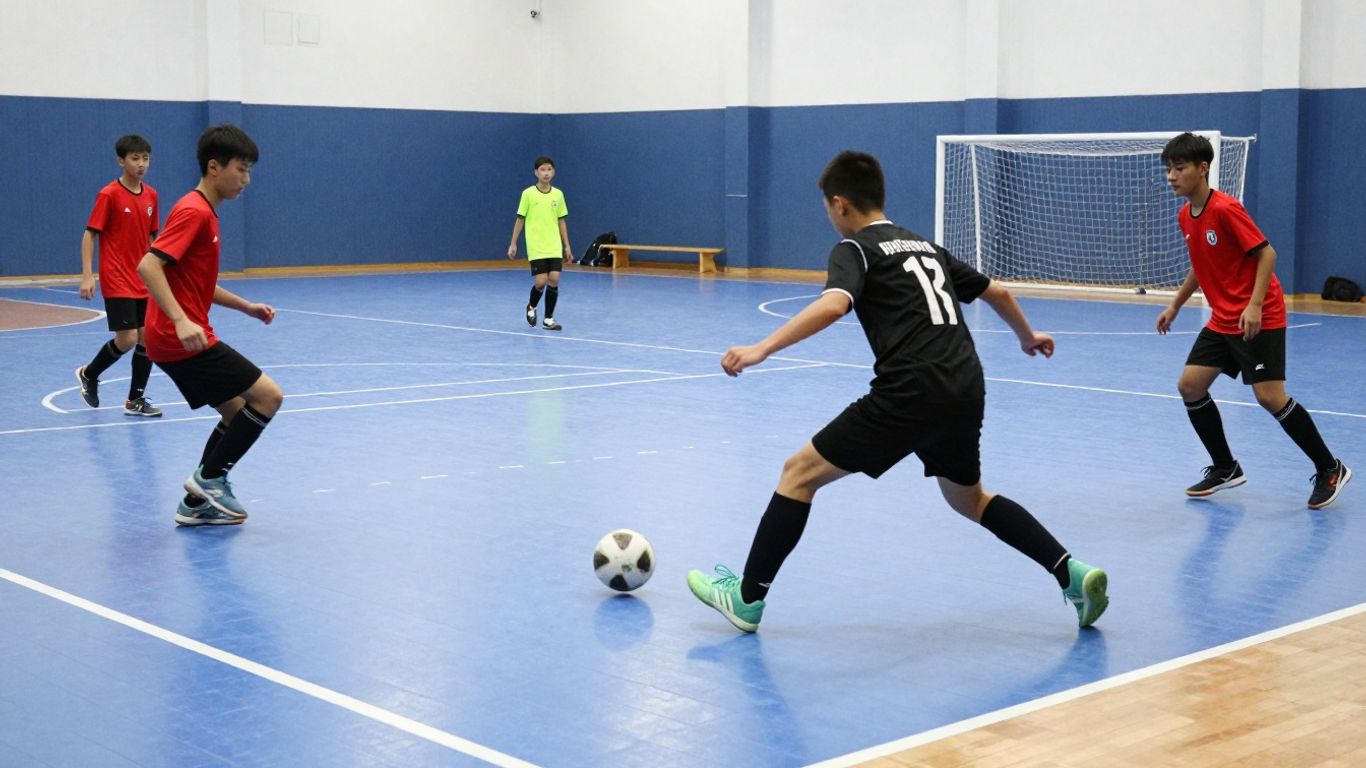
Why futsal courts encourage quick passing
A hard, even futsal court lets the ball move quickly along the floor. Players have less time to take extra touches, and short passing combinations become a practical way to escape pressure. The ball stays in play near the touchlines, so support angles and body position matter from the moment we receive it.
We encourage players to scan before the pass arrives, open their body, and know where the next option is. The aim is not simply to pass quickly, but to make the next decision easier for a teammate.
How grass affects speed and ball control
Grass changes the ball’s speed and bounce. A damp or longer surface may slow a pass, while an uneven patch can lift the ball unexpectedly. Outdoor players need to adjust the weight of a pass, the angle of a first touch, and the timing of a run.
This can make outdoor training feel less predictable, but that unpredictability is useful. It teaches players to observe the surface and adapt their technique instead of relying on one perfect contact every time.
The role of traction and footwear
Footwear should match the surface and the rules of the venue. Futsal shoes generally have a flat, non-marking sole for indoor courts, while outdoor boots are selected according to the ground and the type of studs permitted. Good traction supports balance, but it cannot replace controlled movement.
We also remind young players that new footwear should be tested gradually. Comfort, fit, and the ability to move naturally matter more than choosing the most elaborate-looking pair.
Adapting to artificial turf and hard courts
Artificial turf can provide a more consistent roll than grass, though it may feel faster and place different demands on turning and stopping. Hard outdoor courts reward clean technique but offer less forgiveness when a player falls or mistimes a challenge. Each venue has its own rules for footwear and warm-up areas.
Before a session, we can spend a few minutes passing, dribbling, and changing direction on the actual surface. That simple check helps players adjust their touch before the game becomes competitive.
Comparing skills and tactics
Futsal and outdoor soccer develop overlapping skills, but they present them in different conditions. Futsal compresses the decision-making window, while outdoor soccer gives players more time to use space and coordinate larger team movements. Neither format replaces the other; each can reveal habits that we can improve.
Close control in tight spaces
Futsal places players close to opponents and teammates, so first touches need to protect the ball immediately. Soles, insteps, and quick changes of direction can all help, but the main lesson is to keep the ball within playing distance. Close control under pressure gives a player more choices when space disappears.
Outdoor soccer also needs close control, particularly near the penalty area or along the touchline. The difference is that the player may have a longer pass or a wider escape route available.
Passing patterns and decision-making
Short wall passes, third-player movements, and quick support are common in futsal because teammates are always nearby. Outdoor soccer uses those ideas too, but it adds switches of play, longer combinations, and passes into larger channels. In both formats, we want the pass to solve a problem rather than simply move the ball.
A helpful coaching question is, “What did the player see before receiving?” This shifts attention from the final pass alone to scanning, body shape, and anticipation.
Defensive pressure and transitions
Futsal can change from attack to defence in a few seconds. If a player loses the ball, the nearest teammates may need to pressure immediately while others protect the goal. Outdoor transitions can also be fast, but the larger field often creates more distance between the ball and the defensive line.
We teach players to react together. One player applies pressure, another covers the next pass, and the rest recover into useful positions rather than chasing the ball independently.
Using width and depth outdoors
Outdoor soccer gives teams room to stretch opponents across the field. Width can open a passing lane inside, while depth gives the ball-carrier a forward option and protects against a turnover. These ideas are present in futsal, but the smaller court makes them shorter and more compressed.
Players moving without the ball are central to this work. A well-timed run can create space for somebody else even when the runner never receives a pass.
Fitness and physical demands
Both formats can be demanding, although the pattern of effort is different. Futsal often involves repeated accelerations, stops, turns, and short recoveries, while outdoor soccer combines bursts of speed with longer periods of movement and positioning. We should prepare players for the actual demands of the game rather than assuming one type of fitness covers everything.
Repeated sprints in futsal
Futsal players may accelerate several times during a short spell on court, then leave the game through a rolling substitution. The intensity can feel high because there is little unused space and opponents are close. Quick recovery between efforts matters, as does the ability to make a clear decision while tired.
This is one reason rotations should be coached rather than treated as a punishment. A player who returns with focus can contribute more than one who stays on court without managing effort.
Endurance during outdoor matches
Outdoor soccer demands the ability to repeat runs over a longer match and cover more ground between attacking and defensive phases. Players may jog, walk, sprint, change direction, and hold a position in the same passage of play. Endurance supports concentration as much as it supports running.
We build this gradually through games, movement exercises, and age-appropriate training. The ball should remain part of much of the work because football fitness is closely linked to decisions and positioning.
Contact, recovery, and injury considerations
Outdoor matches may involve more open-field challenges and longer running strides, while futsal involves frequent turning and close contests for the ball. Neither format is automatically easy on the body. Players need suitable warm-ups, sensible recovery, properly fitted equipment, and coaching that respects age and experience.
If a player feels pain or is worried about an injury, we should stop and seek appropriate professional guidance rather than trying to diagnose the problem ourselves.
Training differences between the formats
Training should reflect the actions players repeat most often in matches. We can use a balanced week that includes technical work, small-sided play, movement quality, and recovery rather than chasing exhaustion as the main measure of progress.
A practical session might include:
- Short passing and receiving under gentle pressure.
- Repeated acceleration followed by controlled recovery.
- Small-sided games with clear transition rules.
- Outdoor movement that includes width, depth, and longer runs.
The value of this mix is its variety. Players learn to transfer close control from the court to the field, while outdoor habits such as scanning space can improve their futsal decisions.
Which format is best for your goals
There is no universal winner in the futsal vs outdoor conversation. The better choice depends on a player’s age, interests, access to facilities, confidence, and current development needs. We can also change the balance over time as those needs develop.
Choosing futsal for technical development
Futsal can be a strong option for players who want frequent involvement with the ball and regular decisions in tight spaces. The smaller team size gives each player meaningful attacking and defensive responsibility. It can also suit families looking for a structured option during periods when outdoor fields are unavailable.
We should still look for a welcoming club and thoughtful coaching. A technically demanding game is most useful when players feel safe enough to try, make mistakes, and try again.
Choosing outdoor soccer for full-field play
Outdoor soccer is a natural fit for players who enjoy longer passes, open running, changing field positions, and the rhythm of a larger team. It gives players a chance to learn how lines work together and how space changes as the ball moves from one side to another.
The larger setting can initially feel less busy for a new player, but it introduces important lessons in patience, positioning, and staying connected to teammates.
Finding the right option for beginners
For beginners, the best format is usually the one that offers regular participation, positive coaching, and a manageable level of challenge. A small-sided outdoor game can be just as useful as futsal, while an experienced beginner may enjoy learning on a full field. We should not assume that one setting suits every child.
A trial session can answer practical questions quickly. Notice whether the player gets involved, understands the instructions, feels comfortable with the group, and wants to return.
Combining both formats in a training plan
Many players benefit from experiencing both. Futsal can sharpen close control and quick support, while outdoor soccer develops wider tactical awareness and endurance. We can treat the formats as connected parts of a football education rather than competing identities.
The key is to manage the overall load. Leave room for rest, school, other activities, and unstructured play so that training remains sustainable and enjoyable.
What you need to get started
Starting does not require a large collection of equipment or a perfect understanding of every rule. We need a safe venue, suitable clothing, a ball, and a willingness to learn. The details become clearer after we know whether the first session is recreational, a club trial, or a formal competition.
Essential futsal equipment
For futsal, players generally need indoor shoes with a non-marking flat sole, shin guards, comfortable sports clothing, and a suitable futsal ball for practice. A water bottle and a small towel are useful during intense sessions. The venue may also set rules about jewellery, bags, and footwear.
We should check the club’s equipment list before buying anything. Borrowing or hiring gear for an initial session can be sensible while a player decides whether the format feels right.
Outdoor soccer gear and clothing
Outdoor players commonly need boots appropriate for the surface, shin guards, socks, a playing kit, and weather-appropriate layers. A light rain jacket or warm top can make a noticeable difference in Australian conditions, especially around early morning or evening training.
Boots should fit securely without restricting movement. We also encourage players to bring water and a change of clothing when weather or ground conditions may shift during the session.
Finding courts, fields, and local leagues
Local councils, schools, community clubs, indoor venues, and football associations are useful places to look for sessions. Ask about age groups, coaching qualifications, playing days, trial arrangements, fees, equipment, and what happens if weather affects an outdoor fixture.
It is worth comparing the practical fit as well as the sporting format. A nearby club with a supportive environment may be a better choice than a distant programme that creates unnecessary travel and pressure.
Preparing for your first match
Before the first match, arrive with enough time to change, meet the coach, and learn the basic rules. We can keep the pre-game focus simple: make a safe first pass, move after releasing the ball, defend with a teammate, and listen for instructions.
The first match is not a test of whether a player belongs. It is an opportunity to notice what feels comfortable, what needs practice, and which parts of the game make us eager to come back.
Frequently Asked Questions
Is futsal the same as indoor soccer?
Futsal is a specific small-sided format with its own rules, court markings, ball, and playing conditions. Indoor soccer can refer to several different formats, so the local rules should be checked rather than treating the terms as interchangeable.
Which format is better for ball control?
Futsal often gives players frequent touches in tight spaces, which can support close control and quick decisions. Outdoor soccer also develops ball control, particularly when players must manage varied surfaces, longer passes, and changing pressure.
Can futsal improve outdoor soccer skills?
Yes, the habits developed in futsal can transfer to outdoor soccer. Players may become more comfortable receiving under pressure, supporting the ball, and making quick decisions, although they still need outdoor training to learn full-field positioning and endurance.
Is futsal more physically demanding than outdoor soccer?
The demands are different rather than simply greater in one format. Futsal features repeated short bursts and frequent turns, while outdoor soccer usually involves longer periods of movement and larger running distances.
What footwear is used for futsal?
Futsal usually requires indoor shoes with a flat, non-marking sole. Players should confirm the venue’s rules, as unsuitable footwear can affect grip, damage the surface, or prevent participation.
Can beginners start with either format?
Most beginners can start with either format if the session is age-appropriate and well coached. The best choice is the one that provides regular involvement, clear instruction, and an environment where the player feels comfortable learning.
Should a player train in both formats?
Training in both can provide a broad set of football experiences. We should balance the schedule with recovery and other commitments, using futsal for tight-space actions and outdoor soccer for wider tactical and physical demands.