Futsal vs outdoor soccer: Key differences, benefits, and how to choose
Key Takeaways
Futsal and outdoor soccer share the same basic aim, but they ask different questions of players. We can use the contrast to choose enjoyable sessions and support steady development.
- Futsal is played on a smaller hard court with fewer players and a lower-bounce ball.
- Outdoor soccer gives players more space for running, switching play, and longer passes.
- Futsal rewards quick decisions, close control, and frequent involvement.
- Outdoor soccer builds endurance, spatial awareness, and comfort over larger distances.
- Playing both formats can give young players a broader and more adaptable skill set.
Understanding the playing environments
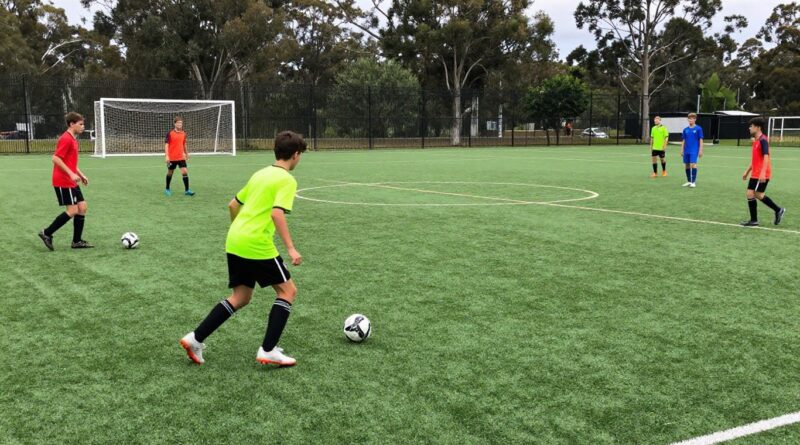
The setting is the first clear difference in futsal vs outdoor soccer. One takes place on a compact court, while the other uses a much larger grass or artificial surface. That change in space affects nearly every action, from receiving a pass to recovering after losing the ball. We should think of the environments as different learning spaces rather than ranking one above the other.
Court size and field dimensions
A futsal court is small enough that players are almost always within passing distance of a teammate or opponent. Outdoor soccer uses a much larger pitch, so players may have time to turn, carry the ball, or make a run into open space before pressure arrives. The difference makes futsal feel compressed and immediate, while outdoor soccer gives greater importance to distance and timing.
Indoor surfaces versus outdoor grass or turf
Futsal is generally played on a firm, smooth indoor surface, although suitable courts may also be outdoors. The ball travels cleanly across the floor and usually stays predictable, so a poor touch is quickly exposed. Outdoor grass and turf vary more in grip, softness, and speed, requiring players to adjust their touch and passing weight.
How boundaries shape the game
Futsal uses marked touchlines and goal lines rather than surrounding walls. When the ball leaves the court, play restarts, which encourages players to protect possession near the boundary and find passing angles before they are closed down. On a large outdoor pitch, the lines are farther apart and can be used to stretch the opposition across the width of the field.
Weather, lighting, and scheduling considerations
Indoor futsal offers more reliable conditions for training, especially when rain, heat, wind, or poor light would disrupt an outdoor session. Outdoor soccer gives us the useful challenge of adapting to changing surfaces and weather. For clubs and families, the practical choice often comes down to venue access, travel time, season, and the availability of suitable sessions.
Comparing the rules and game format
Rules change the rhythm as much as the dimensions do. Futsal typically has fewer players on each side, rolling substitutions, and restarts that must be taken quickly, while outdoor soccer has more space and a different balance between set plays and open play. Learning the rules of each format helps players understand why the game moves the way it does.
Team sizes and player roles
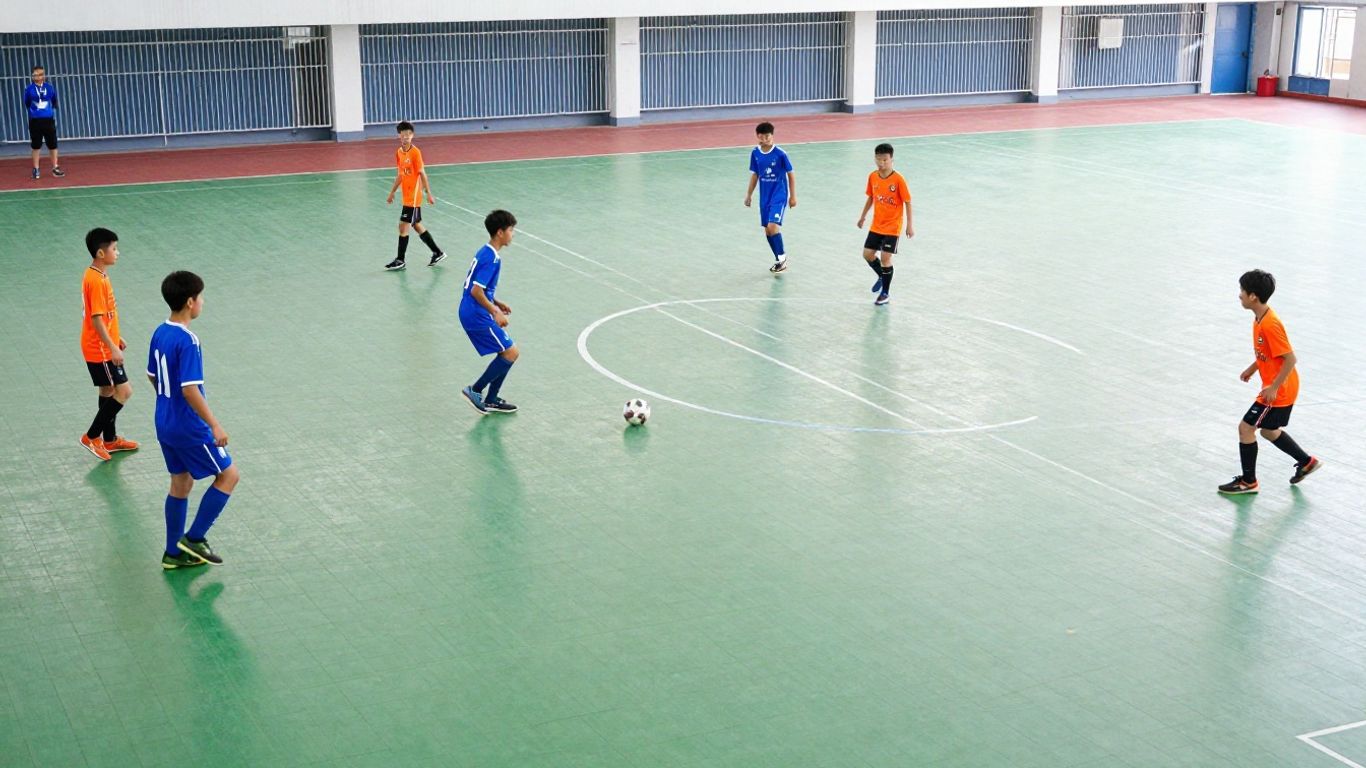
Futsal is commonly played with five players per team, including a goalkeeper. With fewer players covering a smaller area, each player has to contribute in attack and defence. Outdoor soccer usually has larger team formats, so roles can be more specialised, although young players should still experience different positions rather than being fixed in one place.
| Feature | Futsal | Outdoor soccer |
|---|---|---|
| Players on court or field | Commonly five per side | Often larger-sided formats |
| Main spatial demand | Quick support in tight areas | Managing wider and deeper spaces |
| Player involvement | Frequent touches and transitions | Mixture of close play and longer movements |
| Typical role pattern | Flexible attacking and defending | More room for positional specialisation |
The table is a guide rather than a substitute for checking the competition rules. Local leagues can use different age-group formats, but the central contrast remains: futsal brings players into the action more often, while outdoor soccer spreads decisions across a larger team and area.
Match length and substitutions
Futsal matches are commonly organised into two periods of 20 minutes, with the clock and competition rules affecting how that time is managed. Substitutions can be made regularly, allowing players to work in short, intense spells. Outdoor match length and substitution rules vary by age group and competition, so coaches should check the local regulations before planning a session or match.
Restarts, fouls, and goalkeeper rules
Futsal restarts are designed to keep the ball moving quickly, and the goalkeeper has a more restricted role in possession than an outdoor goalkeeper who may handle the ball inside a larger penalty area. Foul accumulation and the details of kick-ins, goal clearances, and time limits can also differ. These rules make players prepare their next action early instead of waiting for the game to slow down.
How rule differences affect decision-making
A player in futsal often has only a moment to scan, receive, protect, and release the ball. Outdoor soccer gives more opportunities to pause, but it also asks players to read longer passes, runs behind the defence, and changes of position away from the ball. The rule set shapes habits, so we should explain the reason behind each rule rather than treating it as a restriction to memorise.
How the ball changes the experience
The ball itself alters the first touch, the speed of a pass, and the confidence needed to shoot. A futsal ball is generally smaller and heavier than an outdoor soccer ball, with a reduced bounce that keeps it closer to the floor. Outdoor balls are designed for a larger surface and a wider range of flight, so they behave differently even when the player uses the same technique.
Futsal ball weight and bounce
The lower bounce of a futsal ball makes it easier to keep the ball on the floor, but it does not make control automatic. Players still need soft feet, a stable body position, and awareness of pressure from behind. Because the ball tends to stay close, sole control and short changes of direction become especially useful in tight areas.
Outdoor soccer ball design
An outdoor soccer ball is built for passing and travelling over greater distances, including through the air. Its flight can be affected by wind, surface conditions, inflation, and the quality of the strike. Players therefore practise a wider range of contacts, from a cushioned first touch to a driven pass or lofted cross.
Passing, trapping, and shooting differences
In futsal, a pass often arrives quickly and must be controlled within a small pocket of space. We usually want the first touch to move the ball away from pressure while keeping it available for the next action. Outdoor soccer allows more varied receiving surfaces and passing distances, so players must judge not only direction but also how much space the ball needs to travel into.
Choosing the right ball for practice
The best practice ball is the one that matches the surface, age group, and purpose of the session. A lower-bounce futsal ball is useful when we want short passing and close control on a court, while an outdoor ball suits work on longer distribution and aerial technique. We should avoid switching between formats without explaining that the ball will require a different touch.
Comparing skills and playing styles
Both formats reward technique, awareness, and teamwork, but they reveal different parts of a player’s game. Futsal places pressure on the first touch and the next decision, whereas outdoor soccer gives more room for carrying the ball and making runs. Strong players learn to transfer principles between the formats without expecting every movement to look identical.
Close control in tight spaces
Futsal gives players repeated opportunities to receive with an opponent nearby. They learn to use small touches, changes of pace, body feints, and shielding to keep possession. This environment can be demanding for beginners, yet it also gives clear feedback: a heavy touch is difficult to hide when the next opponent is only a step away.
Speed and long-distance passing
Outdoor soccer offers more chances to accelerate into open grass and pass across or beyond a defensive line. Players must learn when to play simply at short range and when a longer ball can change the point of attack. The skill is not just striking the ball hard; it is choosing the correct distance, angle, and moment.
One-on-one play and defensive pressure
In futsal, a defender can arrive quickly from several directions, so attackers need a reliable escape and defenders must delay without diving in. Outdoor soccer creates more space for a one-on-one duel, but the defender also has to consider cover, depth, and the run of a second attacker. In both formats, patience is often more useful than rushing at the ball.
Positioning and off-ball movement
Movement away from the ball looks different on a court and a field. Futsal players make short supporting movements, rotate positions, and open a passing lane almost immediately. Outdoor players may make longer diagonal runs, hold width, or move behind a defender over several seconds. We should teach players to ask where the next space will appear, not simply where the ball is now.
Fitness and development benefits
Futsal and outdoor soccer can both provide demanding, enjoyable exercise, though the effort is organised differently. Futsal brings frequent accelerations, stops, turns, and transitions in a small area. Outdoor soccer combines repeated actions with longer periods of running, positioning, and recovery across a larger pitch.
Futsal’s emphasis on quick reactions
The compact court means players must react quickly when possession changes. A player may move from pressing to supporting an attack within a few seconds, then repeat the cycle after a blocked pass. This develops alertness and coordination while making communication a practical part of every possession.
Outdoor soccer’s endurance demands
Outdoor soccer asks players to manage effort over more ground and across a longer match structure. They may sprint to join an attack, recover towards their own goal, then remain available for another phase several minutes later. This encourages pacing, efficient movement, and an understanding that fitness also includes making good decisions when tired.
Building technical confidence through futsal
Regular futsal can help players become comfortable receiving and passing under pressure. They get many chances to try a turn, protect the ball, or combine with a teammate, and mistakes usually lead to another decision almost immediately. Coaches should keep the environment supportive so that technical confidence grows alongside the challenge.
Using each format to improve the other
We can use the formats as complementary training rather than separate worlds. Futsal can sharpen close control and quick support, while outdoor soccer can develop scanning over distance and movement into larger spaces. A simple combined week might include these priorities:
- Close control and short passing under pressure.
- Longer passing, receiving on the move, and switching play.
- Small-sided games that reward support and quick recovery.
- Outdoor games that encourage width, depth, and forward running.
The value comes from connecting the lessons after each session. We can ask players which futsal habits helped outside and which outdoor movements created better options on the court.
Choosing between futsal and outdoor soccer
The right choice depends on the player, the season, the available facilities, and the reason for taking part. We do not need to treat one format as a replacement for the other. A beginner may enjoy the simpler focus of a small-sided game, while another player may be motivated by the freedom and running of a full outdoor session.
Which format suits beginners
Futsal can give beginners frequent contact with the ball and clear opportunities to pass, receive, and defend. Outdoor soccer can feel more open and less crowded, which suits players who enjoy running into space. The best starting point is usually the session that feels welcoming, age-appropriate, and well coached.
The better option for youth player development
For youth development, variety is generally more useful than choosing a single format too early. Futsal can expose players to quick decisions and close control, while outdoor soccer teaches them to understand width, depth, and longer movements. We should also rotate positions and keep competition suitable for the child’s stage of development.
Choosing based on fitness and competition goals
Players seeking short bursts of intense involvement may prefer futsal, while those who enjoy sustained running and larger tactical patterns may prefer outdoor soccer. Competition goals matter as well: the local rules, playing calendar, travel, and level of coaching can shape the experience more than the label of the format. Enjoyment is a practical sign that the choice is working.
How to combine both formats effectively
A balanced approach might use futsal during wet-weather periods, technical blocks, or shorter training windows, then outdoor soccer for wider tactical work and match preparation. We should allow players time to adjust their movement and ball control when changing surfaces. The aim is not to copy a futsal pattern directly into outdoor soccer, but to carry over useful habits such as scanning, supporting, and making the next decision early.
Frequently Asked Questions
Is futsal the same as indoor soccer?
No. Futsal has its own rules, court markings, ball, and playing format. Indoor soccer can use different surfaces, boundaries, team sizes, and laws, so we should check the local competition details.
Which game is harder, futsal or outdoor soccer?
Neither is simply harder. Futsal is demanding because decisions and transitions happen quickly, while outdoor soccer requires players to cover more ground and understand larger spaces.
Does futsal help outdoor soccer players?
Yes, it can help players practise close control, quick passing, receiving under pressure, and supporting the ball. Those skills can transfer to outdoor soccer when players also learn how to adapt them to a larger pitch.
Can beginners start with futsal?
Yes. Futsal gives beginners regular involvement and many chances to practise basic skills. A supportive coach and suitable rules matter more than choosing one format as universally best.
Why does a futsal ball bounce less?
A lower-bounce ball is designed to stay closer to the playing surface. This supports controlled passing and receiving on a compact court, although players still need good technique to manage it under pressure.
Should young players specialise in one format?
Early variety can be valuable because each format develops different movements, decisions, and spatial habits. We should consider the child’s enjoyment, development stage, access, and coaching quality before making a narrow choice.
How often should players switch between futsal and outdoor soccer?
There is no single schedule for every player. Switching when facilities, seasons, and development goals allow can be useful, provided players have enough time to adjust to the different ball, surface, space, and rules.