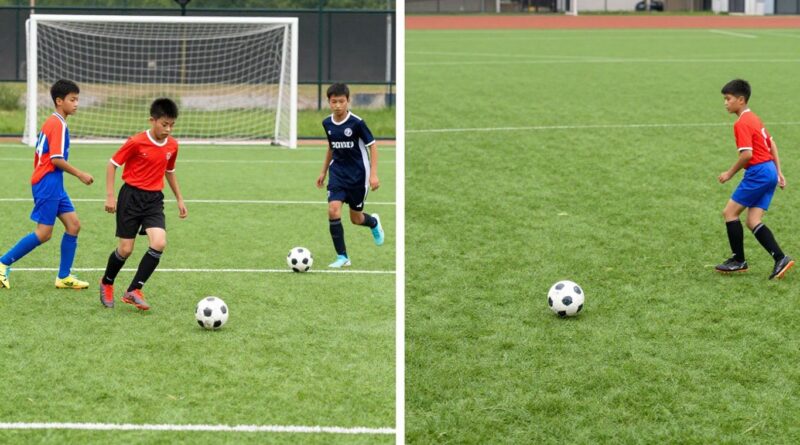
Futsal vs outdoor soccer: How the games differ
Key Takeaways
Futsal and outdoor soccer share a core aim, but their spaces, equipment and rules call for different decisions. We can use the contrasts to choose a format and prepare players for each one.
- Futsal is played on a compact court, while outdoor soccer uses a much larger field.
- A futsal team has five players on court, including the goalkeeper; outdoor formats vary, with 11-a-side common.
- Futsal uses a smaller, lower-bounce ball and kick-ins at the touchline.
- Close control and quick support matter in both games, though outdoor soccer offers more room for longer passes.
- Players switching formats should expect to adjust their spacing, movement and footwear to the surface and rules.
Playing area and equipment
The most visible difference in futsal vs outdoor soccer is the space available. Futsal is played on a marked court, typically with a hard, flat surface and no surrounding walls. Outdoor soccer takes place on a larger grass or artificial-turf field, where the extra room changes how players move and use the ball.
Court size and field dimensions
Futsal courts are compact, but their exact dimensions can vary with the level and venue. International matches use courts within the dimensions set by the rules, while community facilities may adapt markings to fit the space. Outdoor fields also vary in size, although formal competitions follow specified ranges. The practical difference is clear: players in futsal meet pressure quickly, while an outdoor field can stretch a team across greater distances.
Surface types and their effect on play
A futsal court is generally hard and smooth, so the ball travels cleanly along the floor and can move quickly between players. Outdoor fields are commonly grass or artificial turf, and the ball’s speed and bounce can change with the surface and conditions. We should help juniors notice those differences rather than expect every pass or first touch to behave the same way. Surface familiarity matters, particularly when a player is moving between venues.
Futsal ball versus outdoor soccer ball
Futsal uses a smaller ball with reduced bounce compared with the standard outdoor ball. That lower bounce makes it easier to keep the ball close on a hard court, though players still need to cushion and guide it deliberately. Outdoor soccer usually uses a larger ball that can travel further through open space. The contrast is not simply about ball size: it changes how a player receives, carries and passes.
Goals, boundaries, and footwear
Futsal goals are smaller than outdoor soccer goals, and the court is bounded by lines rather than boards. When the ball crosses a touchline, play restarts from that line; it does not rebound off a wall. Outdoor fields have larger goals and boundary lines around the pitch. Footwear should suit the venue: court shoes are generally designed for firm indoor surfaces, while outdoor boots are made for grass or turf. Players should follow the facility’s rules and choose footwear appropriate to the surface.
Teams and game format
The team format shapes how often players are involved and how quickly they need to rotate. Futsal is a small-sided game, so each player is close to the action and has less time to settle on the ball. Outdoor soccer can be played in several formats, with 11-a-side common in the full-field game. The rules for match length, substitutions and restarts depend on the competition, so we should check the local format before play.
Number of players on each side
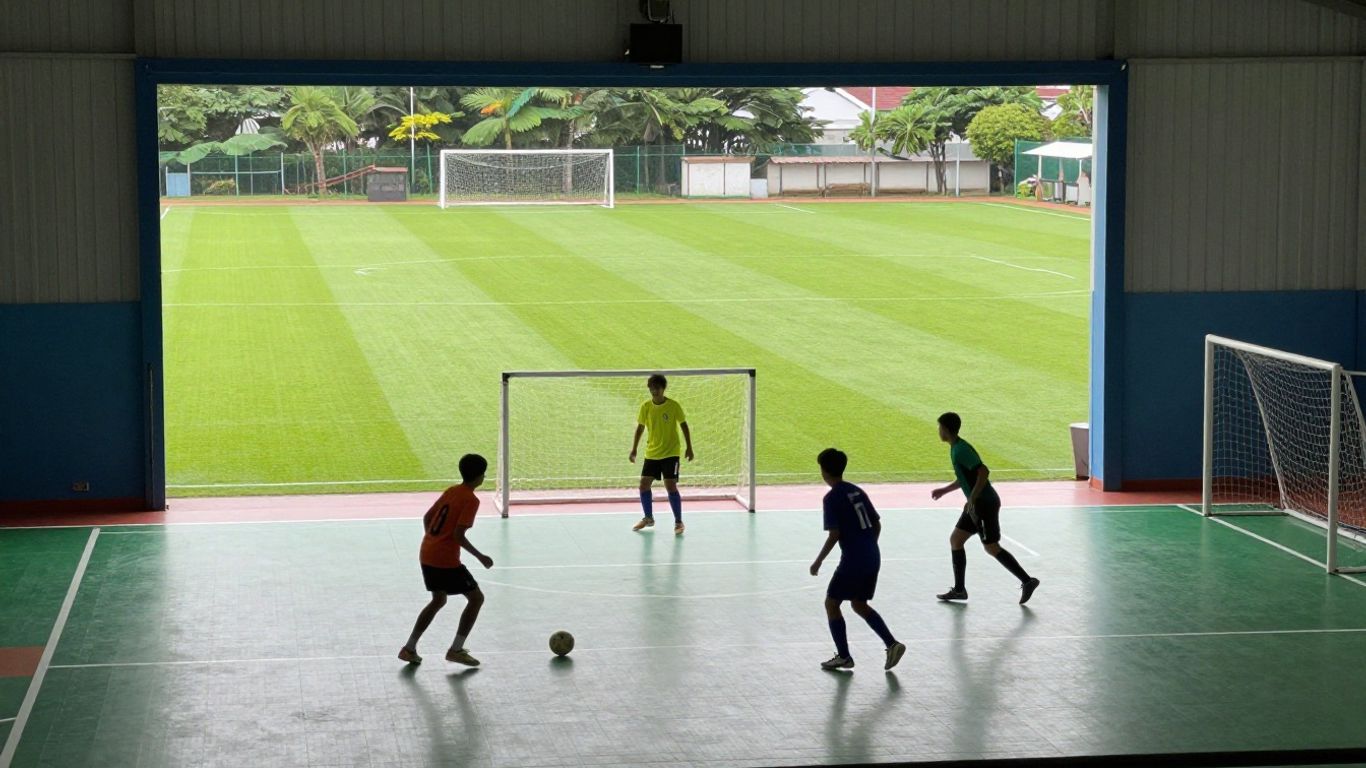
Futsal is played with five players on court per team, including a goalkeeper. With fewer players sharing a compact space, players often switch between attacking and defending within the same passage of play. Outdoor soccer formats vary by age group and competition; the full-field version commonly has 11 players per side. Smaller outdoor formats reduce those numbers, but they still use a field with more room than a futsal court.
Substitutions and player rotation
Futsal rules generally allow repeated rolling substitutions, so players can enter and leave without waiting for a single break in play. That supports short rotations and can keep the pace high. Substitution rules in outdoor soccer depend on the competition, and changes may be limited or tied to stoppages. For junior teams, we can plan rotations so everyone understands when to come off, where to wait and how to rejoin play safely.
Match length and breaks
At the senior international level, futsal is commonly played in two 20-minute periods of effective playing time, with the clock stopped for certain interruptions. Local and junior competitions may use different durations or timing rules. Outdoor match lengths also vary by age group and competition, and the clock generally continues through much of the play. We should confirm the match format in advance; it affects substitutions, warm-ups and how players manage their effort.
Goalkeeper roles in each game
Both games give the goalkeeper a central defensive role, but the space and rules change the details. A futsal goalkeeper has a smaller goal to protect and may become involved in quick exchanges as the team builds from the back. In outdoor soccer, the larger field gives the goalkeeper a wider area to organise, and long distribution can help move play upfield. In either format, good communication and sensible decisions matter as much as shot-stopping.
Rules and pace of play
Futsal and outdoor soccer share familiar aims, but some key rules create different rhythms. The court’s boundaries, the treatment of fouls and the absence of offside in futsal all affect players’ choices. Outdoor soccer follows its own versions of these rules, with details shaped by the competition. We can teach the main contrasts while reminding players to check the rules in force for their match.
Touchline restarts and kick-ins
When the ball goes over a futsal touchline, play restarts with a kick-in rather than a throw-in. Players must take the restart promptly and opponents must respect the required distance. In outdoor soccer, a ball that crosses the touchline is returned with a throw-in. The different technique is simple to learn, but it changes how a team can restart and how quickly opponents can press.
Fouls, accumulated fouls, and penalties
Futsal tracks team fouls within each half. After a team reaches the competition’s accumulated-foul limit, later direct-free-kick fouls can lead to a special direct shot without a defensive wall, taken from the appropriate mark under the rules. This gives teams a reason to defend with care rather than rely on repeated contact. Outdoor soccer also awards free kicks and penalties, but it does not use the same accumulated-foul system. Exact procedures can vary with the rules of the competition.
Offside rules and player positioning
There is no offside rule in futsal, so an attacker can position close to the opposing goal without being penalised for offside. The team still needs support and timing; standing forward without a useful passing option can leave teammates isolated. Outdoor soccer applies an offside rule, which asks attackers to coordinate runs with the ball and the defensive line. That difference makes awareness of space and timing important in both games, though in distinct ways.
How the rules shape the tempo
Quick restarts, frequent transitions and the smaller playing area help make futsal feel continuous and fast. The rules do not mean every moment has to be rushed; players still benefit from scanning and choosing a useful option. A simple comparison helps show how the formats influence decisions:
| Match feature | Futsal | Outdoor soccer |
|---|---|---|
| Touchline restart | Kick-in | Throw-in |
| Offside | Not used | Used in standard formats |
| Team fouls | Accumulated within each half | No equivalent futsal count |
| Playing space | Compact court | Larger field |
These are broad contrasts, not a replacement for the competition’s rulebook. Once players understand them, we can practise the right restart and positioning habits before match day.
Ball control and player skills
Both formats ask players to control the ball, find teammates and make good choices under pressure. Futsal’s smaller playing area tends to bring opponents closer, while outdoor soccer can give a player more time or room in some parts of the field. Neither game is a shortcut to mastering the other. We can treat them as related formats that reward adaptable technique and awareness.
Why futsal rewards close control
In futsal, a player often receives the ball with an opponent nearby and little space to carry it. A calm first touch can keep possession alive, while a heavy touch may send the ball into pressure. Players benefit from using the sole of the foot as well as the inside and outside, and from keeping their body between the ball and a defender. The aim is not fancy footwork for its own sake; it is to keep the next option available.
Passing and decision-making in tight spaces
Futsal encourages players to scan early, pass accurately and move after releasing the ball. Short combinations can open a route forward, but only when teammates offer useful angles and distances. We can ask juniors to notice what happens before the pass: where the pressure is coming from, which teammate is free and whether a first-time option is safe. That habit helps players make quicker, clearer decisions without turning every touch into a hurried one.
How outdoor soccer uses longer passes
On a larger outdoor field, players can use longer passes to switch play, find a teammate in space or move the ball beyond a line of pressure. Those passes require a different sense of distance and weight from quick futsal combinations. A player may also need to take a touch and look up before choosing a target. Longer distribution is not always the best choice, though; a short pass can still be the clearest route forward.
Skills that transfer between the games
Some habits travel well between formats, even though the conditions change. This comparison can help us focus training without treating the games as identical:
| Skill | In futsal | In outdoor soccer |
|---|---|---|
| First touch | Protect the ball in close pressure | Set up a pass, carry or longer touch |
| Scanning | Find an immediate option | Read wider spaces and longer passing lanes |
| Support play | Offer short, quick passing angles | Balance nearby support with depth and width |
| Passing | Keep combinations precise and controlled | Adjust range and weight to the field |
Players can carry over awareness, balance and the habit of supporting a teammate. The way they apply those skills should change with the ball, surface and amount of space available.
Tactics, movement, and fitness
A compact court and a full outdoor field ask teams to organise themselves differently. Futsal players can move through tight passing patterns, while outdoor players have more room to stretch the defence and use depth. Both formats involve repeated changes between attacking and defending, though the distances and recovery periods vary. We can teach movement as a response to the game, rather than ask players to run simply for the sake of covering ground.
Creating space on a futsal court
On a futsal court, space often appears when players move away from the ball and pull defenders with them. A teammate can then offer a passing lane, rotate into a new position or make a short run beyond the defence. These movements work best when the team keeps its shape and players communicate. If everyone moves towards the ball, the court gets crowded and the team has fewer clear options.
Using width and depth on an outdoor field
Outdoor teams can use the width of the field to spread opponents and create room for a forward pass. Depth matters too: players can support the ball from behind while others make runs ahead of it. We should help younger players recognise when to stretch out and when to come closer to support. A wide position is only useful if the player remains connected to the play and can receive or help defend.
Differences in sprinting and endurance demands
Futsal often involves short bursts of movement, quick changes of direction and brief opportunities to rotate. Outdoor soccer can include longer runs across a larger area, alongside short sprints and periods of lower-intensity movement. The exact demands depend on the role, match and level of play. For coaches, the practical point is to prepare players for the movement patterns of their format, while keeping training age-appropriate and varied.
How defensive approaches change
Futsal’s limited space can make a coordinated press effective, but a poorly timed challenge may leave a teammate exposed. Teams may also defend in a compact shape and look for a chance to win the ball together. Outdoors, defenders can protect greater distances, shift across the field and decide when to hold a line or apply pressure. Across both formats, communication and patience help prevent players from chasing the ball and leaving gaps behind them.
Choosing between futsal and outdoor soccer
There is no single right choice for every player or team. Futsal offers a small-sided setting where players repeatedly engage with the ball, while outdoor soccer gives players a larger field and different tactical problems. We can choose based on what is available, what the player enjoys and which skills the team wants to practise. Many juniors benefit from experiencing both formats over time.
Which game suits your goals and playing style
Players who enjoy close combinations and quick changes of direction may like futsal’s compact setting. Those drawn to longer runs, wider team shapes and bigger fields may prefer outdoor soccer. These are tendencies, not rules about who can thrive in each game. We can encourage juniors to try both, since preferences often change as they become more comfortable with different roles and team-mates.
What to expect when switching from one game to the other
A player moving from futsal to outdoor soccer may initially find the extra space unfamiliar and overhit short passes. Moving in the other direction can feel crowded, with less time to turn or carry the ball. We can ease the transition by practising the appropriate ball, restart and spacing before asking players to adapt under match pressure. A few deliberate adjustments are often more useful than trying to play both games in exactly the same way.
How to prepare for each surface and format
Before a session or match, we can check the venue, footwear requirements and local rules. A short preparation routine gives players a chance to feel the ball and surface before the game begins:
- Confirm whether the session is on a futsal court, grass or artificial turf.
- Use a ball suited to the format and facility.
- Review the relevant restart and substitution rules with the team.
- Practise receiving and passing at distances that fit the playing area.
That preparation helps players settle into the game rather than spend the opening minutes adjusting to unfamiliar conditions. It also gives coaches a natural moment to remind juniors that the formats share a foundation, but reward different choices.
Frequently Asked Questions
Is futsal the same as indoor soccer?
Not necessarily. Futsal has its own rules and is played on a marked court without surrounding walls; other indoor soccer formats may use different surfaces, boundaries and rules.
How many players are on a futsal team?
Futsal is played with five players on court per team, including the goalkeeper. Competitions may also specify how substitutes are managed.
Is there an offside rule in futsal?
No. Futsal does not use the offside rule, unlike standard outdoor soccer formats.
Why does a futsal ball bounce less?
A futsal ball is designed with reduced bounce compared with a standard outdoor ball. This helps players keep it close on a hard court.
Can futsal be played outdoors?
It can be played outside on a suitable flat, hard surface if the facility and local rules allow it. Players should use appropriate footwear and check the conditions before play.
Which game is better for beginners?
Neither format is best for every beginner. Futsal offers frequent involvement in a compact space, while outdoor soccer introduces players to a larger field and wider team shape.
What should players change when switching formats?
Players should adjust their first touch, passing distance, positioning and footwear to suit the ball, surface, space and rules of the new format.