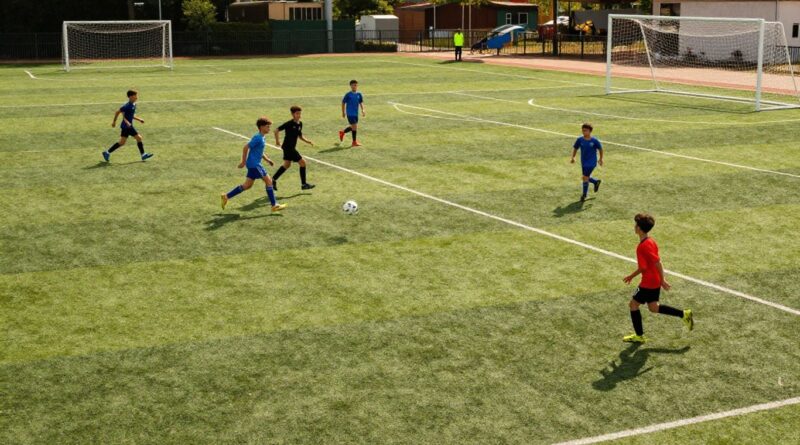
Futsal vs outdoor soccer: Key differences, benefits, and how to choose
Key Takeaways
Futsal and outdoor soccer share the same basic aim, but the smaller game creates a very different learning environment. We can choose one or combine both depending on our goals, access, age, and playing preferences.
- Futsal is usually a five-a-side game on a smaller, hard court with a low-bounce ball.
- Outdoor soccer uses a much larger field, often with more players and greater space between roles.
- Futsal encourages close control, quick decisions, and frequent involvement.
- Outdoor soccer develops longer passing, positional awareness, running power, and space management.
- Playing both formats can help us build a broader and more adaptable skill set.
Understanding the basic differences between futsal and outdoor soccer
Futsal and outdoor soccer are related, but they ask players to solve different problems. Futsal brings the action into a compact space, while outdoor soccer gives players more room to run, pass, and organise. The result is not a choice between a “real” game and a smaller version; each format has its own rhythm and value.
Number of players and team roles
A standard futsal team has five players on court, including a goalkeeper. With fewer teammates around us, every player has to contribute in attack and defence, and roles can change within seconds. Outdoor soccer commonly uses larger teams, which allows more specialised positions and clearer distances between defenders, midfielders, and attackers.
In futsal, we may defend one moment and become the next passing option immediately afterwards. Outdoor players still need all-round awareness, but the size of the field makes it easier for a player to hold a particular area or role for longer.
Match length, substitutions, and game flow
Futsal matches are generally played in two 20-minute periods, with the clock managed differently from a typical outdoor match. Rolling substitutions help maintain a fast tempo, so players can leave and re-enter as the coach manages intensity. Outdoor match formats vary by age and competition, and substitutions may be more limited or controlled.
The smaller court means the ball is often back in play quickly. There is little time to switch off after a pass, misplaced touch, or lost challenge. Outdoor soccer tends to include longer phases of movement without the ball, along with more obvious changes between building an attack and defending one.
How the rules shape the playing experience
Futsal uses touchline boundaries rather than surrounding walls, and restarts are designed to keep the game moving. The low-bounce ball and compact court reward players who can receive under pressure and make a useful decision quickly. Outdoor soccer places more emphasis on managing larger spaces, aerial balls, longer restarts, and changing field positions.
The rules influence behaviour more than we sometimes realise. In futsal, holding the ball for too long can close several options at once; outdoors, a player may have time to carry the ball or wait for a run. That contrast is central to understanding futsal vs outdoor soccer.
Comparing courts, surfaces, and playing conditions
The playing environment changes how the ball travels and how our bodies move. Futsal is usually played on a marked hard court with a controlled bounce, while outdoor soccer can take place on natural grass or artificial turf. The available space, surface grip, and weather all affect technique, comfort, and decision-making.
A useful comparison begins with what we can see and feel during a session: how quickly the ball rolls, how much room we have to turn, and how confidently we can accelerate or stop.
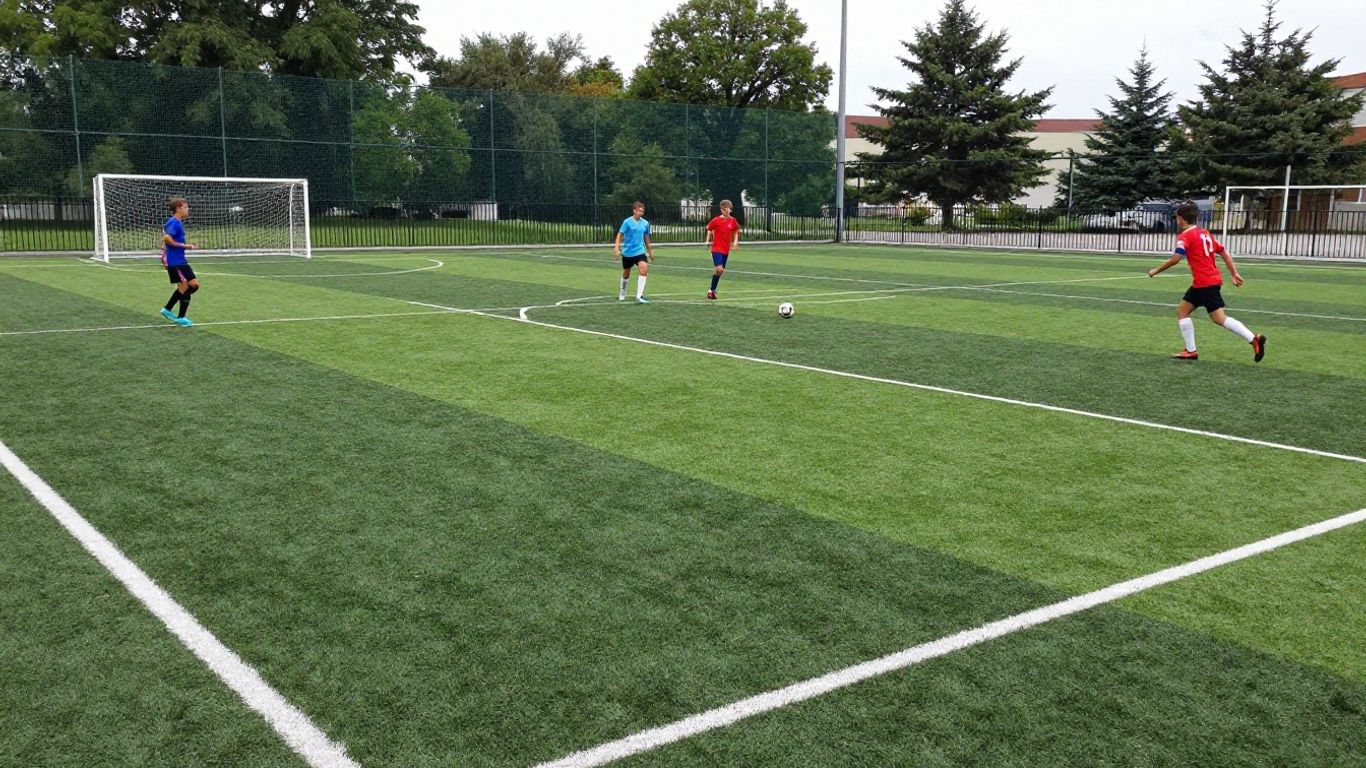
Indoor futsal courts and low-bounce surfaces
Futsal courts are compact and commonly have a smooth, hard surface. The ball stays relatively close to the ground, making controlled passes and quick receiving touches especially important. Players need to adjust their body shape because opponents can arrive from several directions in a short time.
Indoor conditions also remove many interruptions caused by wind and rain. That consistency can make technical practice easier to repeat, although the hard surface demands sensible footwear and careful movement.
Outdoor fields, grass, and artificial turf
Outdoor fields provide substantially more room for passing, running, and changing the point of attack. Natural grass can vary in length, firmness, and moisture, while artificial turf usually offers a more consistent surface but may feel different underfoot. We should learn to adapt rather than expect every pitch to behave in the same way.
The larger field also changes the importance of the first touch. A touch into open space may be useful outdoors, whereas the same touch could simply give an opponent possession on a futsal court.
How space and weather affect each game
Futsal offers a more predictable setting, which is useful when we want uninterrupted practice and repeated involvement. Outdoor soccer introduces wind, sun, rain, uneven ground, and temperature changes. These conditions affect passing weight, balance, recovery, and communication.
Space matters just as much as weather. A player who looks crowded indoors may find more time outdoors, while an outdoor player may need to become much sharper when the available passing lanes shrink.
Futsal vs outdoor soccer equipment
The equipment looks similar at first glance, but small differences matter. The ball, shoes, and goalkeeper clothing should suit the surface and the demands of the format. We do not need the most expensive gear; we need equipment that fits properly, meets the competition rules, and helps us move safely and confidently.
Futsal balls and outdoor soccer balls
A futsal ball is typically smaller and designed to bounce less than an outdoor soccer ball. That makes it easier to keep close on a hard court and encourages calm control during quick exchanges. Outdoor balls are generally built for larger spaces, longer passes, and a wider range of flight and bounce.
When training, we should use the ball that matches the skill we are trying to practise. A futsal ball can help us work on close touches, while an outdoor ball gives us a more relevant feel for longer distribution and crossing.
Shoes, shin guards, and goalkeeper gear
Futsal shoes are made for grip on indoor court surfaces and usually have a flat, non-marking sole. Outdoor boots are selected according to the playing surface, such as firm ground, artificial turf, or soft ground. Wearing the wrong sole can reduce traction and make changes of direction less comfortable.
Shin guards are important in both formats, and goalkeepers need gloves suited to their match conditions. We should check league requirements before buying specialist gear, particularly for young players who may grow quickly.
Choosing equipment for training and match play
Training equipment can be simple, provided it matches the surface and the activity. For match play, rules may specify ball type, footwear, protective equipment, or goalkeeper colours. A quick check with the club or competition organiser can prevent avoidable problems.
A sensible equipment checklist is more useful than chasing every new product:
- Choose shoes for the actual court, grass, or turf surface.
- Use a ball with the right size, weight, and bounce for the format.
- Make sure shin guards fit securely beneath the socks.
- Check that goalkeeper gloves and clothing are comfortable and competition-appropriate.
This approach keeps the focus on playing well rather than on equipment distractions. Good gear supports movement, but it does not replace practice or awareness.
How each format develops soccer skills
Both formats can develop strong footballers, although they place different demands on attention and execution. Futsal gives us many short decisions in a small area, while outdoor soccer asks us to recognise patterns across a much larger space. We can use that difference to plan purposeful training rather than treating one format as automatically better.
Touches, close control, and quick decisions in futsal
Futsal often gives players repeated chances to receive, pass, turn, and recover the ball. Since pressure arrives quickly, we learn to scan before receiving and to protect the ball with our body. A controlled sole roll, short pass, or first-time lay-off can be more useful than an elaborate move.
The format rewards early information gathering. If we check our shoulder before the pass arrives, we have a better chance of knowing whether to turn, pass back, or play forward immediately.
Passing range, speed, and positioning outdoors
Outdoor soccer develops the ability to pass across greater distances and to judge when to move into open space. Players learn that a good position may be several metres away from the ball, creating a passing lane or stretching the defence. Running with the ball also becomes more important because there is room to attack space.
The game teaches patience as well as speed. We may need to circulate possession, switch play, or wait for a teammate to move before attempting the next pass.
Which format best supports individual improvement
The best format depends on the skill we need to improve. Futsal can give a developing player more frequent involvement and faster feedback, while outdoor soccer provides valuable lessons in positioning, timing, and field awareness. Neither format covers every demand on its own.
We can make progress by setting a clear purpose for each session. A futsal game may be chosen for receiving under pressure, while an outdoor session may focus on movement behind a defensive line or delivering an accurate longer pass.
Differences in tactics, fitness, and teamwork
The tactical language changes with the size of the playing area. Futsal teams combine close support, rotations, and rapid transitions, whereas outdoor teams must manage larger gaps and longer recovery runs. In both games, players need to understand not only where the ball is but where the next danger or opportunity will appear.
Fitness also has a tactical side. We are not simply trying to run more; we are trying to repeat useful actions while staying alert.
Attacking patterns in tight spaces
Futsal attacks often depend on triangles, quick wall passes, rotations, and movement away from the ball. A player may move to create space for a teammate rather than receive the next pass. Because the court is small, one clean combination can open a shooting chance almost immediately.
Players should avoid standing behind defenders or crowding the ball. Supporting at a useful angle gives the ball carrier more than one safe option and helps the team keep possession.
Defensive responsibilities and transition play
In futsal, losing the ball can expose the goal quickly, so the nearest player must often apply pressure while teammates protect the central area. Outdoor teams also need to react after turnovers, but the larger field may provide more time to recover shape. Communication is essential in both formats.
Defending is not only about tackling. We can delay the attack, block a passing lane, track a runner, or guide play away from danger. A team that understands these choices is usually more composed during transitions.
Endurance, acceleration, and repeated sprints
Futsal involves frequent accelerations, stops, changes of direction, and short recovery periods. Outdoor soccer includes these actions too, but the longer distances can demand more sustained running and repeated efforts into open space. The exact physical load depends on age, position, playing level, and match conditions.
We should build fitness through football actions where possible: moving into support, recovering after losing possession, pressing with a teammate, and repeating short runs with quality. Fitness is most useful when it allows us to make better decisions late in a game.
Benefits and potential drawbacks of each format
Choosing between futsal and outdoor soccer is easier when we are honest about what each setting offers. Futsal can provide more touches and a lively indoor option, while outdoor soccer gives us a broader tactical and physical experience. Both also have limitations, especially when the format does not match a player’s age, confidence, or practical circumstances.
Why players choose futsal
Futsal suits players who enjoy constant involvement and quick combinations. The smaller court can make it easier for a developing player to understand support angles, defensive cover, and the value of a first touch. Indoor sessions are also useful when outdoor weather or pitch availability makes regular training difficult.
The main challenge is the intensity of the decision cycle. Players who are still learning may feel rushed, so coaches should create activities that reward composure rather than simply demanding speed.
What outdoor soccer offers that futsal cannot
Outdoor soccer gives players a full-sized field on which to learn long passing, wide attacking, defensive recovery, and the patience needed to manage large spaces. It also exposes players to changing surfaces and weather, which are part of normal football life. Goalkeepers, defenders, midfielders, and forwards can experience more specialised positional demands.
The trade-off is that a player may go longer without touching the ball. We need to teach young players that scanning, moving, and supporting still count as active participation.
Common challenges for beginners in both formats
Beginners can struggle with the speed of play, unfamiliar rules, or the physical confidence needed to challenge for the ball. In futsal, the compact space may feel overwhelming; outdoors, the size of the field can make positioning seem unclear. These reactions are normal and usually improve with patient repetition.
A supportive starting point includes:
- Clear instructions using simple football language.
- Small-sided activities that give players regular involvement.
- Encouragement to make a decision rather than fear every mistake.
- Time to practise receiving, passing, and moving without pressure.
Once players understand what the next action might be, the game becomes less chaotic. We can then raise the speed and complexity gradually.
How to choose between futsal and outdoor soccer
There is no single correct answer for every player or season. We should consider what we want to learn, which facilities we can reach, and how much intensity we can manage comfortably. A good decision is practical as well as technical; the best format is often the one we can attend consistently.
Matching the format to your goals
If our priority is close control, quick passing, and receiving under pressure, futsal may be a strong choice. If we want to work on longer distribution, positional play, running into space, and outdoor match habits, outdoor soccer may fit better. We can also alternate formats so that one exposes gaps the other does not.
The most useful question is not which game is superior. It is which game gives us the right challenge at this stage of development.
Considering age, experience, and fitness level
Younger or newer players often benefit from games that provide frequent touches and clear involvement, although the activity should still be adapted to their confidence and physical development. More experienced players may enjoy the extra tactical and physical demands of a larger outdoor game. Coaches and families should pay attention to enjoyment, recovery, and the quality of instruction.
We should also consider travel, cost, equipment, and scheduling. A convenient session attended regularly will usually be more valuable than an ideal session that is difficult to sustain.
Using both formats to become a more complete player
Futsal can sharpen close control and fast thinking, while outdoor soccer can broaden our understanding of space, distance, and team structure. We can carry lessons between the formats: use futsal habits to improve outdoor receiving, and use outdoor scanning habits to make better choices on a court.
A balanced plan might include indoor technical work during one part of the season and outdoor team play during another. Over time, the combination can help us become more comfortable in tight spaces and more effective when space opens up.
Frequently Asked Questions
Is futsal harder than outdoor soccer?
Neither format is automatically harder. Futsal is often quicker and more demanding in tight spaces, while outdoor soccer can require more running, positional discipline, and awareness across a large field.
Can futsal make us better outdoor soccer players?
Yes, futsal can support outdoor development by giving us practice with close control, quick decisions, short passing, and receiving under pressure. We still need outdoor sessions to learn the distances and positional demands of the larger game.
Is futsal always played indoors?
Futsal is commonly played indoors, but the defining features are the court, rules, team format, and ball rather than simply being inside a building. Local facilities and competitions may vary.
Do futsal and outdoor soccer use the same ball?
No. Futsal balls are generally smaller and have a lower bounce, while outdoor soccer balls are designed for larger fields and different passing and flight demands.
Which shoes should we wear for futsal?
We should wear flat, non-marking shoes made for indoor court surfaces. Outdoor football boots are not usually suitable for a smooth indoor court and may damage the surface or provide poor grip.
Can beginners start with either format?
Yes. Beginners can start with either format if the activities are age-appropriate, supportive, and adjusted to their experience. The best choice is usually the one that feels accessible and can be attended consistently.
Should young players specialise in one format?
Many young players can benefit from experiencing both. Futsal and outdoor soccer develop overlapping skills while presenting different problems, so variety can support broader learning and enjoyment.